202602.06
Self-evaluation in Social Contexts: How Social Acceptance and Rejection Shape the Self (IDAC Research Encouragement Awards)
Posted in EVENT
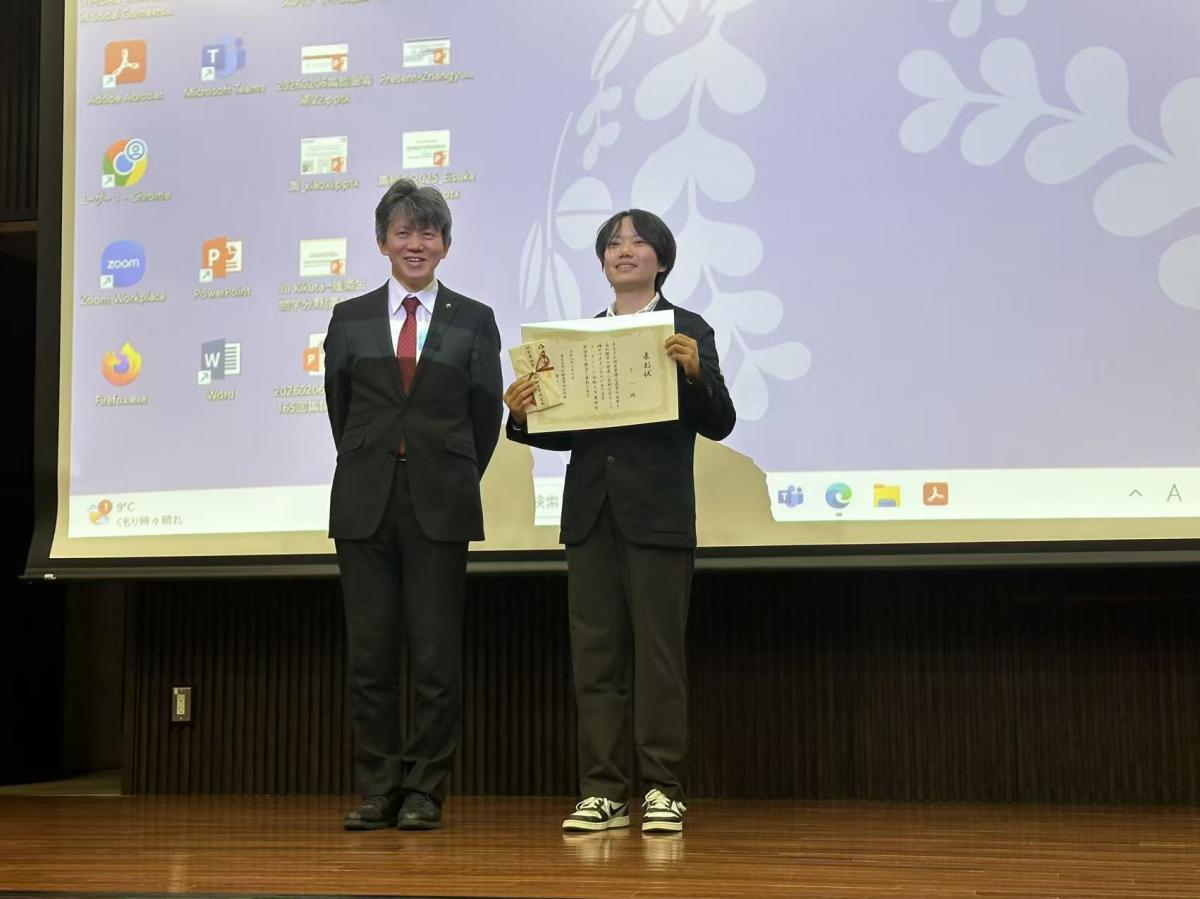
I am honored to receive a Research Encouragement Award at the 165th IDAC Biennial Meeting.
In my award presentation, I introduced a series of studies examining how self-evaluation functions in social life, with a particular focus on social acceptance and rejection. By combining behavioral experiments, functional MRI, and survey data collected during the COVID-19 pandemic, my research aims to demonstrate that self-evaluation is not merely an internal belief but a socially adaptive process.
Across these studies, I showed that self-evaluation is selectively shaped across domains such as morality and competence, reflecting strategies for navigating social relationships. I also discussed how self-related processes are closely linked to social-cognitive processing, helping to explain both resilience and vulnerability in mental health. In addition, I presented work applying this framework to risk perception and coping behavior during the COVID-19 pandemic, highlighting the importance of considering self-related processes in real-world social contexts.
This award is intended to encourage early-career researchers at IDAC who have produced promising research outcomes. Receiving this recognition is deeply motivating, and I am grateful for the opportunity to continue pursuing research that advances our understanding of human behavior within its social context.
I would like to express my sincere appreciation to my collaborators, mentors, and all research participants who contributed to this work. (Ding)

I am honored to receive a Research Encouragement Award at the 165th IDAC Biennial Meeting.
In my award presentation, I introduced a series of studies examining how self-evaluation functions in social life, with a particular focus on social acceptance and rejection. By combining behavioral experiments, functional MRI, and survey data collected during the COVID-19 pandemic, my research aims to demonstrate that self-evaluation is not merely an internal belief but a socially adaptive process.
Across these studies, I showed that self-evaluation is selectively shaped across domains such as morality and competence, reflecting strategies for navigating social relationships. I also discussed how self-related processes are closely linked to social-cognitive processing, helping to explain both resilience and vulnerability in mental health. In addition, I presented work applying this framework to risk perception and coping behavior during the COVID-19 pandemic, highlighting the importance of considering self-related processes in real-world social contexts.
This award is intended to encourage early-career researchers at IDAC who have produced promising research outcomes. Receiving this recognition is deeply motivating, and I am grateful for the opportunity to continue pursuing research that advances our understanding of human behavior within its social context.
I would like to express my sincere appreciation to my collaborators, mentors, and all research participants who contributed to this work. (Ding)